Showing posts with label book review. Show all posts
Review: Spin + Knit 2017, a Spin-Off special issue
Although it's a year or two old now, I learned about this collection of patterns via Kate Larson's blog post about her visit to Shetland, which is a good read.
During that visit she bought a pack of Shetland wool in various shades, which she spun and made into the North Road hat, her own design. The hat is featured on the cover.
I don't generally buy pattern books but I have a few. Usually there are only a few patterns in each that I would actually make and only one or two that I end up making. But it's unusual to find a collection of designs specifically for spin and knit and as usual there were a few that I could see myself making. I almost always spin for a project.
The print edition is sold out, but the digital edition is available. However, it's $14.99 which seems very pricey.
It contains 20 patterns and a number of articles. You can see all of the patterns here. There are hats, mitts, scarves, cowls and shawls. They tend to be smaller projects, which you'd expect in a handspinning collection, but there are a couple of bigger projects too, a colourwork bag and a cardy. I really like the Basketcase Cardigan and it's one of the projects that I have firm plans for.
It has 120 pages and the articles that accompany that patterns are well-chosen for a spinner/knitter. Or maybe even a knitter who's curious about spinning, because there's a good 'Spinning Basics' article by Maggie Casey. There's plenty for the more experienced too including several 'How to's and a long run-down of sheep breeds.
Here's the link to Kate's blog post once again, and here's the link to buy the digital issue.
Labels:
book review,
knitting,
pattern books,
review,
Spin-Off magazine,
spinning
Review - Hand Spinning - Essential Technical and Creative Skills by Pam Austin
My first impression was that the book undersells itself. The cover certainly could be more eye-catching.
But it's a very well-produced book. 10.5" x 9", glossy, hard-covers with 144 pages and 200 illustrations.
It is aimed at the beginner, with some value for the intermediate spinner too.
Pam runs the Spinning School www.spinningschool.org; she gave me an impromptu lesson in longdraw spinning once at Fibre East and I like her very much.
I associate her with longdraw (woollen) spinning so it's no surprise that there's an emphasis on this technique. It's the first draft that she covers in the book, followed by several others; worsted, short forward, semi-worsted, core-spinning.
I asked myself whether it would be possible to learn to spin using the book and the answer is yes. It begins with an exercise in spinning a small piece of yarn without using a spindle, which helps you to understand how the fibres hold together when twisted and the construction of yarn.
It then proceeds to teach you how to spin using a spindle (which I believe any good teacher would do before going to a wheel) with plenty of pictures.
Much that you'll need to know is covered; the anatomy of a wheel and choosing the right one, recognising a good fleece, other fibres, animal and plant, carding, plying, Andean plying, colour theory, dyeing. It finishes with the spiritual 'Mindfulness and art'. The list of chapters below doesn't tell the full story, for example, carding is well covered; rolags punis, hand carders, flick carder, blending board, drum carders. But this is within chapter 4 and not mentioned in the chapter title.
While imagining myself as a new spinner, I did notice that it may be necessary to skip around a little bit. As I mentioned, the book begins with the first steps toward producing your own yarn. But it's then necessary to move forward several chapters (or read them) before finding plying.
Colour theory has a whole chapter. Dyeing has a chapter too. It covers commercial dyes and some techniques, and then two natural dyeing techniques: indigo and walnuts. Pam explains at the end of the chapter "The techniques in this chapter were chosen for their ease of use and satisfying results." This desire to convey the magic of the craft is clearly something that Pam feels, and I did feel that running through the book.
"Bewitched and bewildered" is an intriguing chapter title. She says (quite rightly) "It's so easy to become bewitched by beautiful wheels and bewildered by conflicting advice." The chapter aims to help steer you through all of this and make the right decisions for you.
The style is reassuringly formal. Not too matter-of-fact and not too casual. Something that I found satisfying is that each chapter begins "The aim of this chapter is..." and ends "In a nutshell..." with a summary.
Chapters:
Introduction
1. One thread at a time
2. Bewitched and bewildered
3. Essential spinning techniques
4. Sheep fleece: nature's best
5. Fibres for hand spinning
6. Plying and finishing yarn
7. Colour in spinning
8. Dyeing to dye
9. Yarn structure
10. Mindfulness and art
Further reading
Glossary
Natural colours and natural dyeing are part of Pam's outlook but I'm sure that it would have been possible to have conveyed this with a more eye-catching cover. This goes for some of the photographs in the instructional section, which lack a bit of brightness and clarity.
That aside, it's a large, glossy, hardback book It would be a good companion to a new spinner, Pam's attitude as a teacher is evident and she aims to inspire mindfulness, art and creativity in her readers.
I've tried to be objective. I have a copy which I'm giving away in August's Hand Spinning News.
You can buy a copy of the book directly from Pam's site:
http://www.spinningschool.org/product/hand-spinning-essential-technical-and-creative-skills/
Labels:
book review,
drop spindle,
spinning,
spinning wheel
Plant Dyes for All Seasons 2017 Calendar
Fran Rushworth of Wool - Tribulations of Hand Spinning and Herbal Dyeing has sent me a copy of this wonderful calendar for review.
She has been learning about plant growing and dyeing by trial and error for some years and blogging about her successes and failures on her website. With this calendar, she aims to create what she would have wished for when she started out.
The first thing to say is that Fran has made the copies of this calendar herself. I don't mean that she's sent her photographs to the printers and chosen a boilerplate layout. She has actually printed*, spiral bound and hole punched it all herself. This, along with her choice of a good matt paper rather than gloss, gives the calendar a 'homespun' look, which is appealing and in keeping with the subject. Personally, I think I'd like to have seen glossy card used on the front cover, for a slightly more polished look. But the paper is good quality heavy stuff and the matt finish works really well for the rest of the content, for reasons that I'm about to move onto.
The second important thing to say about this is that far from being a dozen nice glossy pictures to hang on your wall, which is what I'd imagined when Fran told me that she was producing a calendar, she's written what amounts to an instructional booklet.
If you follow the succinct instructions that are revealed each month, you'll learn a lot about natural dyeing and have fun along the way. projects include bark, leaves & flowers, galls & acorns, solar dyeing, contact printing. Sowing, planting out and harvesting are covered at the appropriate times. It has as much to do with experimentation as how to get the perfect result. At the front is a page of suggestions, things to buy, things to save, things to gather in preparation for your journey.
Oh yes - it's also a calendar.... a month filling half of the A3 spread means that there's room to write important notes about those important dates.
The calendar is available for £7.50 plus p&p. For no extra charge, you can have a personal greeting printed on the back, conveyed by Fran's companion, Elinor Gotland.
More shots and information about how to grab yourself a copy of this original and appealing item are here.
* Update, 15 Nov. Because of a surprising response to her initial blog post, Fran has had to ask a local print shop to help with the actual printing of the pages, using the same weight paper that she had already been using. She's still putting the calendar together herself.
She has been learning about plant growing and dyeing by trial and error for some years and blogging about her successes and failures on her website. With this calendar, she aims to create what she would have wished for when she started out.
The first thing to say is that Fran has made the copies of this calendar herself. I don't mean that she's sent her photographs to the printers and chosen a boilerplate layout. She has actually printed*, spiral bound and hole punched it all herself. This, along with her choice of a good matt paper rather than gloss, gives the calendar a 'homespun' look, which is appealing and in keeping with the subject. Personally, I think I'd like to have seen glossy card used on the front cover, for a slightly more polished look. But the paper is good quality heavy stuff and the matt finish works really well for the rest of the content, for reasons that I'm about to move onto.
The second important thing to say about this is that far from being a dozen nice glossy pictures to hang on your wall, which is what I'd imagined when Fran told me that she was producing a calendar, she's written what amounts to an instructional booklet.
If you follow the succinct instructions that are revealed each month, you'll learn a lot about natural dyeing and have fun along the way. projects include bark, leaves & flowers, galls & acorns, solar dyeing, contact printing. Sowing, planting out and harvesting are covered at the appropriate times. It has as much to do with experimentation as how to get the perfect result. At the front is a page of suggestions, things to buy, things to save, things to gather in preparation for your journey.
Oh yes - it's also a calendar.... a month filling half of the A3 spread means that there's room to write important notes about those important dates.
The calendar is available for £7.50 plus p&p. For no extra charge, you can have a personal greeting printed on the back, conveyed by Fran's companion, Elinor Gotland.
More shots and information about how to grab yourself a copy of this original and appealing item are here.
* Update, 15 Nov. Because of a surprising response to her initial blog post, Fran has had to ask a local print shop to help with the actual printing of the pages, using the same weight paper that she had already been using. She's still putting the calendar together herself.
Roisin Wrist/Ankle Warmers from Yarn Works by W J Johnson
Yarn Works is a new book subtitled How to Spin, Dye and Knit Your Own Yarn. It's aimed at knitters who are interested in spinning and dyeing.
I received the book for review and decided that the best way would be to work one of the projects.
The book is organised into 4 main sections; Fibre workshop, Spinning workshop, Dyeing workshop and Knitting workshop. This meant that for working one of the projects meant referring back to various earlier pages for details of mordanting, using the cochineal and spinning. I was also a little confused by quantities; I found a contradiction re quantity of dyestuff needed and the quantity of fibre / yarn given in the project is far more than actually needed to make the item. This last point isn't a problem at all, the yarn is beautiful and I have enough left over now to make a bigger project.
The project I chose is simple, spinning alpaca appealed to me and I've not used cochineal before (if you find the idea of using the actual bugs a bit grizzly then there are powder or liquid options). The pattern is just 16 stitches knit until long enough but a garter edge, a cable pattern and buttonholes make it interesting.
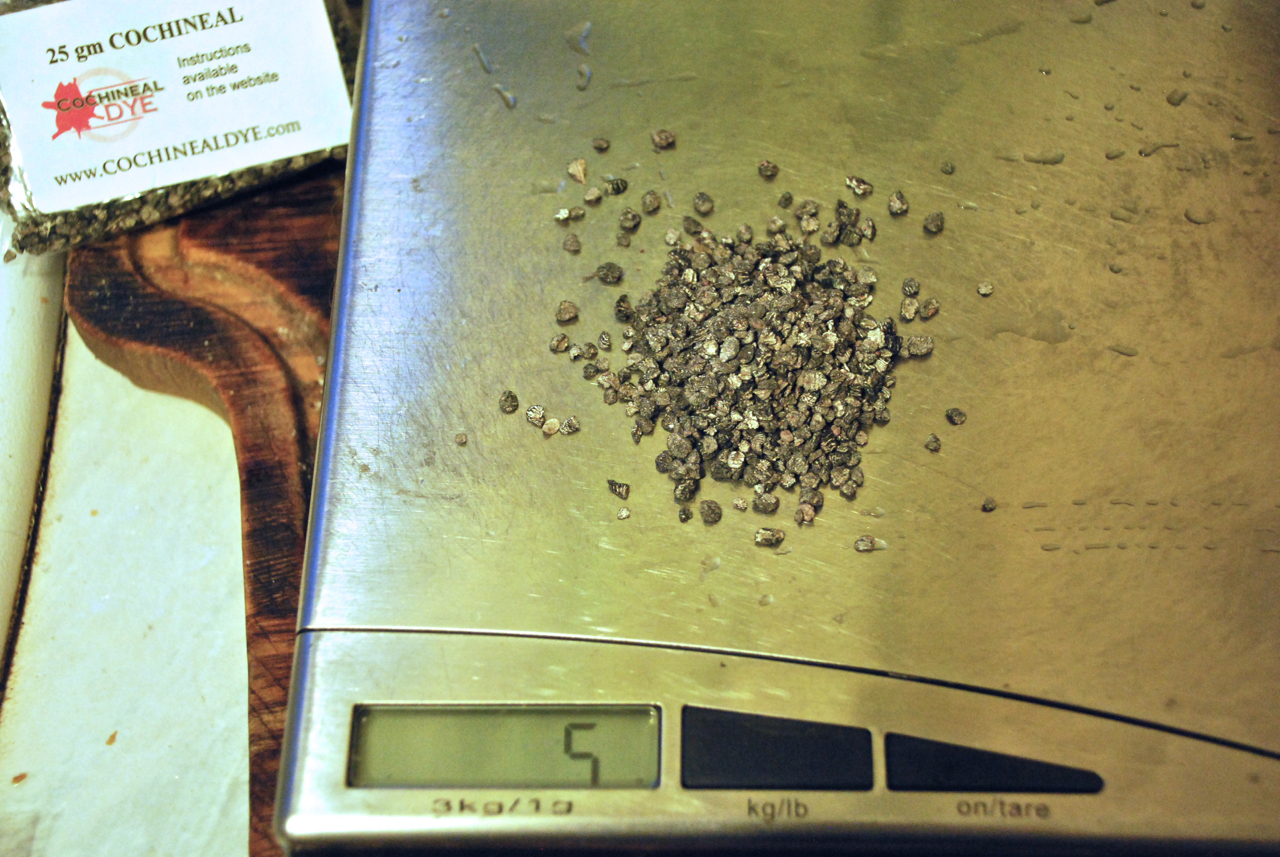
Cochineal gives alpaca a lovely dusky rose colour. The fibre I used is a bit pricey but it's beautiful to work with. I went with the quantity of cochineal given in the Dye workshop section, a remarkably small pile of bugs. The dye wasn't quite exhausted after a prolonged simmer, so they really do seem to contain a lot of colour.
Beware - alpaca is very easy to felt, so handle carefully when dyeing, rinsing and drying.
The book suggested carding locks and spinning from rolags. This is the only instruction I didn't follow to the letter. I spun my prepared roving woollen by spinning from the fold. After navajo-plying the yarn is very soft and nice and even.
The warmers were a very quick knit, each one a single sitting, or maybe even both in a single sitting if you knit quickly or can sit for longer than me. My buttons are from Helen Dixon.
There's a large appendices section at the end. Some of this information is detailed information on topics such as fibre blending, determining WPI and twist count, troubleshooting your wheel, the colour wheel and mixing dyes. This would all seem to fit well in the relevant chapters, but I assume that this more advanced information has been separated out to keep the workshops uncomplicated for those trying the techniques for the first time. There's an appendix about making various tools on the cheap if you're on a budget. There's also a wealth of reference information such as weights & measures and knitting abbreviations.
More of my pictures from this project are here on Flickr
I received the book for review and decided that the best way would be to work one of the projects.
The book is organised into 4 main sections; Fibre workshop, Spinning workshop, Dyeing workshop and Knitting workshop. This meant that for working one of the projects meant referring back to various earlier pages for details of mordanting, using the cochineal and spinning. I was also a little confused by quantities; I found a contradiction re quantity of dyestuff needed and the quantity of fibre / yarn given in the project is far more than actually needed to make the item. This last point isn't a problem at all, the yarn is beautiful and I have enough left over now to make a bigger project.
The project I chose is simple, spinning alpaca appealed to me and I've not used cochineal before (if you find the idea of using the actual bugs a bit grizzly then there are powder or liquid options). The pattern is just 16 stitches knit until long enough but a garter edge, a cable pattern and buttonholes make it interesting.
Cochineal gives alpaca a lovely dusky rose colour. The fibre I used is a bit pricey but it's beautiful to work with. I went with the quantity of cochineal given in the Dye workshop section, a remarkably small pile of bugs. The dye wasn't quite exhausted after a prolonged simmer, so they really do seem to contain a lot of colour.
The book suggested carding locks and spinning from rolags. This is the only instruction I didn't follow to the letter. I spun my prepared roving woollen by spinning from the fold. After navajo-plying the yarn is very soft and nice and even.
The warmers were a very quick knit, each one a single sitting, or maybe even both in a single sitting if you knit quickly or can sit for longer than me. My buttons are from Helen Dixon.
There's a large appendices section at the end. Some of this information is detailed information on topics such as fibre blending, determining WPI and twist count, troubleshooting your wheel, the colour wheel and mixing dyes. This would all seem to fit well in the relevant chapters, but I assume that this more advanced information has been separated out to keep the workshops uncomplicated for those trying the techniques for the first time. There's an appendix about making various tools on the cheap if you're on a budget. There's also a wealth of reference information such as weights & measures and knitting abbreviations.
More of my pictures from this project are here on Flickr
Book review: Hand Spun by Lexi Boeger
New Spins on Traditional TechniquesContents:
- Fiber Preparation: Dyed in the Wool
- Spinning Techniques: Learning vs Discovery
- New Twists: Expanding Traditional Techniques
- Permutations Gallery: Putting it all Together
- Projects: Keeping it Simple
- Appendix: Interview You!
Having Alison Daykin as a teacher might have steered me in the direction of art yarn, but I find that the yarns I like making most are thin, smooth and even.
Despite this I find Lexi Boeger's work outstanding. A while ago I featured a selection of her photographs in my newsletter.
The first section of the book covers preparation and carding of your raw fibre and contents of your 'treasure box'.
The techniques follow. I was expecting the usual: thick/thin, slubby, core and coil, but this is a big book and the techniques go on and on with techniques and many variations that you may not have seen before.
I think of art yarn as yarn which looks beautiful as yarn. The term 'art yarn' is used in the book, but far from wanting you to make yarn that you only admire in it's own right, Lexi intends that you use what you make. she proposes keeping the stitching very simple, allowing the yarn to speak for itself. The twenty projects - yes twenty - include a fly-fishing dry-fly. That may be a first!
I have to be honest and say that while I find almost all of the pictures of the yarn really appealing, only a few of the projects grab me. However, it goes beyond knit & crochet and they serve to demonstrate some imaginative ways to use your yarn.
In addition to all of this, the book has an enjoyable introduction from Owen Poad of Majacraft, a gallery, some profiles / interviews with artists and Lexi's tips.
The jacket says that this is a 'well rounded' book and it certainly is. Nicely-designed, well-illustrated with sufficient and accessible text. it covers the subject very well, from preparation through to finished projects.
I was doubtful about whether to order this book but when it arrived, I was immediately drawn in and although I didn't have the time to sit down and read it properly straight away, I couldn't walk past it without picking it up and flicking through it.
Check out pluckyfluff online http://www.pluckyfluff.com/yarn.html to see what Lexi does and if you like those images, then you'll love this book.
160 pages, paperback, £16.99
Subscribe to:
Posts (Atom)