Showing posts with label knitting. Show all posts

Knitting a rubik's cube

I made this cube for my boyfriend, he's not just good at them; he can solve them one-handed while riding a unicycle, or tackle this kind of thing.

This isn't instructions or a pattern, it's just a blog post about what I did. However, I made it up as I went along, so if you have a little bit of knitting experience, I'm sure you could do the same.

It's not just a dust-gatherer. It does have some other functions, which I'll mention as I go along.

Cotton yarn won't pill or stretch and this particular yarn comes in a selection of nice bright colours. I don't think the type or weight of yarn is important, but as with toys I guess a nice tight gauge is best because you don't want the stuffing to show through. I knit that yarn on 4mm needles.

6 rows by 6 stitches seemed about right, plus a couple of stitches and rows to allow for mattress-stitching. So 8x8. You'll obviously want 9 little squares of each of 6 colours.


That's a lot of tails! Long ones are useful for stitching up. There's no weaving-in because they'll all be lost inside and help to fill the finished item.

It's vital to find a diagram of an actual scrambled cube, or use a real scrambled cube as a guide. If you place the colours randomly, it probably won't be solvable and is the equivalent of giving a musician a card with nonsense musical notes on it. 
I used this online generator for the image above. It's about 25 moves from being solved, but unfortunately I didn't save that solution and it's now lost. But that does give the knitted one another function as a puzzle: find the shortest solution from this state.

As mentioned, I used mattress stitch to sew the small squares into big squares, and then the big squares into the arrangement in the diagram and finally sewed that into the 3D shape, all bar one edge.

Most of the time you're mattress-stitching stitches that go in the same direction, but it's necessary to sew vertical to horizontal along some edges, which is harder to make neat.

I used duplicate stitch to add the black as I went along . 


A lavender bag adds another function. I understand that lavender is also a spider-deterrent, which is yet another function.
I buried the lavender bag in the middle, surrounded by regular toy stuffing and the numerous ends.
Once sewn up, the same duplicate stitch can be used along the edges.
The stuffing wants to push the cube out into a ball. I had  hoped that the stitched edges, and the lack of stretch in the cotton yarn would help hold the cube shape. I packed this in a cube-shaped box in order to help form the cube shape. 


This year his cake was also a cube and featured the same pattern, but without the colours on the bottom side. 


casting on Madragoa

A few months ago Mum was given a bag containing a half-finished project and the accompanying balls of yarn. 

It was of interest to me because the yarn felt really special. I've temporarily misplaced the other balls and can't check a label but it has a good percentage of real wool.

The natural first thought was to complete the project but there were some problems with that. Several patterns were present but we couldn't establish which was being used. There were some mistakes in the work, and it was obviously being made to a specific size which would be unlikely to fit either of us. 

So I decided to use the yarn to knit a similar cardy in a style and size to suit me. I'm not sure how far the unopened balls will go, whether I'll have to also unravel the unfinished work, or even whether there's enough yarn to finish what I've chosen, but I've started anyway! (I have chosen something very open and light, so I think the yarn should go a long way.)

The pattern I've chosen is Madragoa by Filipa Carneiro. By coincidence the pattern shows one in a very similar colour but the style is one that I'll want to wear. The construction isn't straightforward but this is a plus because it keeps it interesting.  You start with the lacework at the back of the collar with a provisional cast-on, work so far one way and hold the stitches, then work from the provisional cast-on the other way for the same distance before adding picked-up stitches along the side of what you've done. That's where I'm at, and you can see that I'm about to add the markers.


Spellcaster socks - finished

When Pantone announced the colour of the year for 2024, I realised that I had to get a wiggle on and finish these socks before Viva Magenta stopped being the colour of the year.

I love the colour and the pattern. The problems have been distractions by other projects and a new craft and the fact that spinning a 3-ply yarn by spindle took a long time. (A habit such as #spin15aday could have really helped here.)

The fibre is 'Aries' from the Fibre Hut, a wool/silk mix (which I can no longer see on the Fibre Hut site but is available from World of Wool). It was the closest colour I could find at the time to Viva Magenta. Hopefully the silk will give the yarn some strength. It's 3-ply and I tried to spin the singles more tighly than usual.  

The pattern is Spellcaster Adventure Socks by Clair Wyvern. Many of the pattern choices are made with the roll of a die, so no two pairs will be alike. This is a great idea which I enjoyed very much and I'll look for more such patterns.

I did make a mistake on the second sock, the very last of the triangular patterns isn't the right one. That's not very obvious and I was so keen to get them finished in time for the holiday that I didn't want to rip back and repeat so many rounds. 

A tip for anyone making these socks is that if you roll the 'added chaos' option of knitting the charts upside-down as I did, then the cable crossings as charted don't work. It's kinda noted in the pattern and obvious with hindsight but I didn't spot that when I started. I *think* left crosses have to be right crosses and vice versa, but it makes my head hurt to try to visualise it.  Either way, I didn't reverse the direction of my cables and they didn't really work as intended. I didn't realise this until halfway down the first sock and continued with what I was doing. 

Leaf Cravat by Teva Durham in handspun yarn


 This can be made to wrap once or twice around the neck and worn tied or untied.

This is quite popular with handspinners and there are some examples here.

I have some yarn that I spun for socks. The details of the fibre are lost to time but I think it's a wool/silk mix. I spun the singles finely and made a three-ply, aiming for sock-weight but it's probably closer to DK and this is probably the reason that two attempts at making socks from it failed.

This pattern calls for a sport-weight ('5-ply'). My yarn probably isn't far off and I think I have the right amount - we'll see when I reach the end. 

The leaf cravat has a shaped leaf at each end and to make them match you knit the first one from the blunt end and then pick up stitches at your cast-on end. The scarf section isn't a quick, plain knit but requires some concentration. I appreciated the more interesting knit and it certainly makes a more attractive scarf. 

For these unusually short rows I tried three types of needle before settling on the 8" Knitpro Zing DPNs. SPNs were unnecessarily heavy and unwiedly. A circular was awkward because the cable had nothing on it and kept springing into the way (I should have tried a shorter cable). The Zing dpns are perfect, they're very light, just the right length and the rounder points work well with this yarn.

Note that this is knitted lace and my pictures show unblocked pieces. There will still be some shape / curl to them after light blocking. 

It is a quick knit. I'm not a fast knitter but expect to finish this in four or five evenings.

Remedial work to the handspun BBC Micro jumper

 A while ago I finished this project,  


You may think the neck looks a little odd or a little wide. It certainly felt that way to me. The truth is that I ran out of yarn with maybe a a few rounds left to go. I'd used all of the John Arbon fibre and didn't think it worth ordering another 100g just for that tiny bit of extra yarn.

I haven't worn the jumper much, and I think that's because I wasn't entirely happy with it.

One great thing about the John Arbon blends is that they are very consistent. So I was able to order another 100g and it's an exact match. I didn't snap a shot while I was spinning the singles, but here's the plied yarn. 

It's a 4-ply with one of the plies being this pink silk. I probably had enough on the bobbin but still had some of the fibre and enjoyed using my John Brightwell wheel to spin a little more of that. 

And so onto the remedial work.... 
Here's the neck as it was. There are only two or three rounds of 2x2 rib there and it needs a bit more. It was easy to retrieve the woven-in end, undo my final knot and pull out the bind-off giving me a round of live stitches. 

Here's the result. You can see that the new yarn is indistinguishable from the old, and that the neckline looks much better. I decreased a couple of stitches at the point of the V.


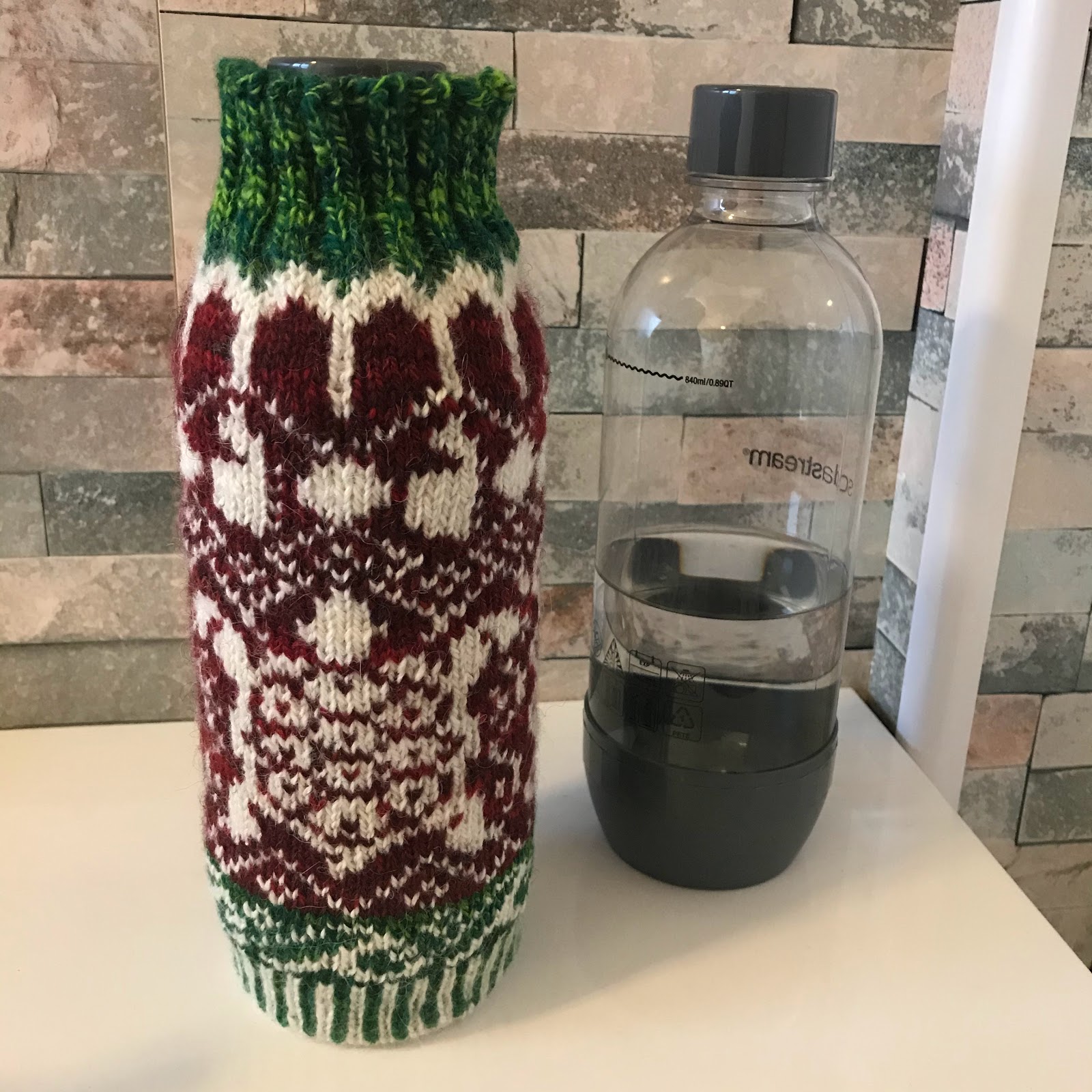
Finished handspun project, Mango and Family Bottle Sock by Vivienne Morgan

I'm a recent convert to Soda Stream. I was buying big bottles of fizzy water regularly but felt that I was creating plastic waste.  

I like to take one of these bottles walking with me, but the bottles get scuffed while rattling around in the rucksack.

That's where Vivienne Morgan's bottle sock comes in! 

It's like a sock without a heel. She has three bottle sock patterns to choose from. For my first I chose Mango and Family, based on a real-life tortoise, which seems appropriate for my walking. It reminds me of an Aztec design, hence the bold colours I chose. I later felt that they look too Christmassy but hey ho. 

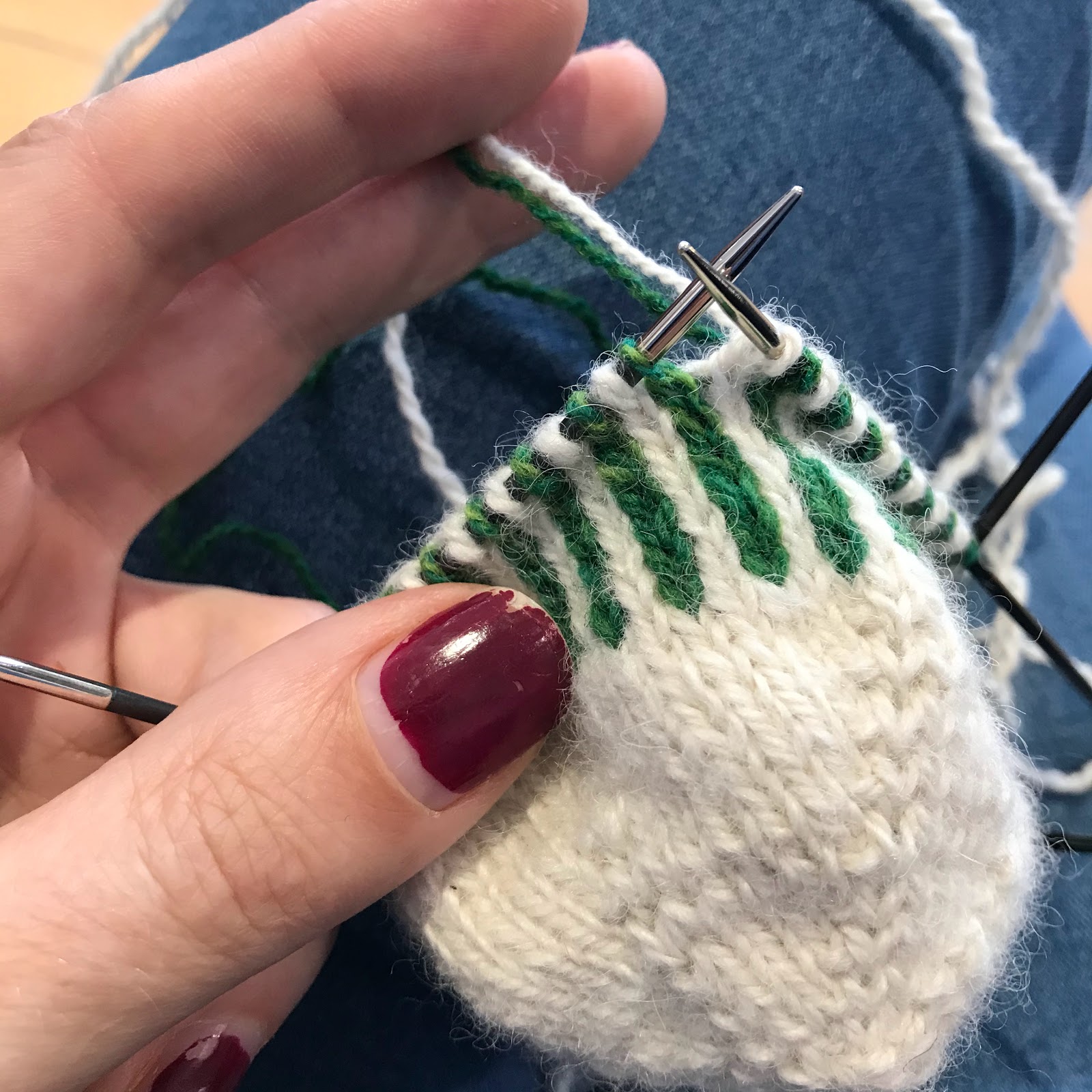
I spun the white yarn especially. I had some white Real Shetland from Adam Curtis. It's very silky and a pleasure to spin.  The green and dark red were handspun yarn from stash, I think these would be Spinzilla or Tour de Fleece spins from a year gone by. 

I spent some time on the early part while waiting for my car MOT at the end of October
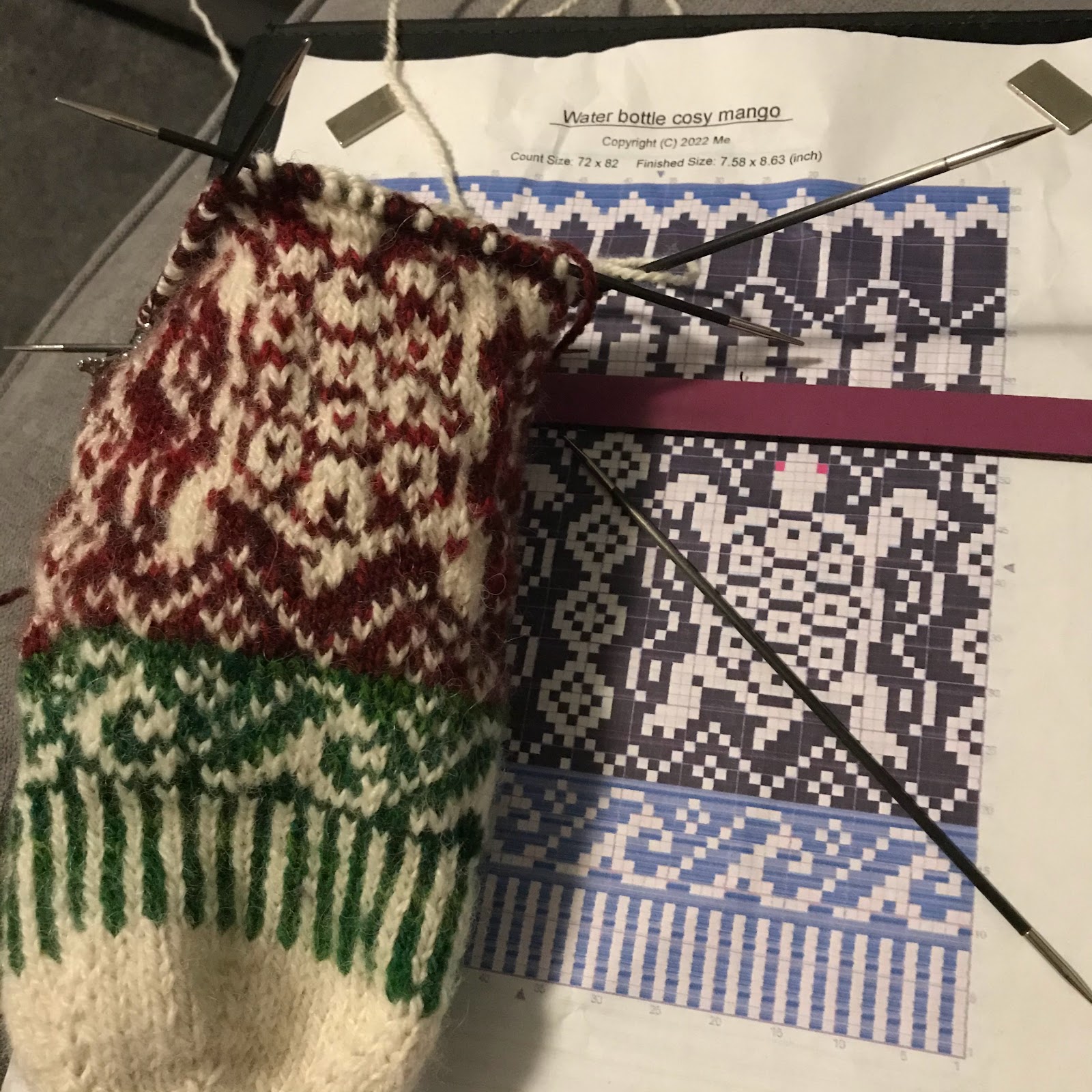
The main part of the pattern went very quickly. It was a pleasure to knit. I don't think there were any floats longer than 5 or 6 stitches, so no need for faffing around crossing the yarn. 

I was curious about whether it would be wide enough. In Vivienne's pictures, it looks as if she's using a bottle which is slimmer than mine, so I was ready to add stitches or go up in needle size. But after reaching the body, it did seem about right. It went over the bottle for blocking and now slips on and off easily. 

It's a breeze to knit if you already know stranded colourwork. As Vivienne says, there's no second sock syndrome, although if you're like me, you'll enjoy this so much, you'll immediately want to make another.


Split-personality jumper update

 This is looking very good. Making a 4-ply yarn has given a very round and even yarn with a good thickness. Previous post about the spinning experiments here.

The software produced a pattern for a raglan jumper knit in pieces. This is the back, starting at the waist. It seems a little small but it'll probably block out to the right size, the lace / rib pattern is extremely stretchy.


Finished handspun Earth Mama legwarmers

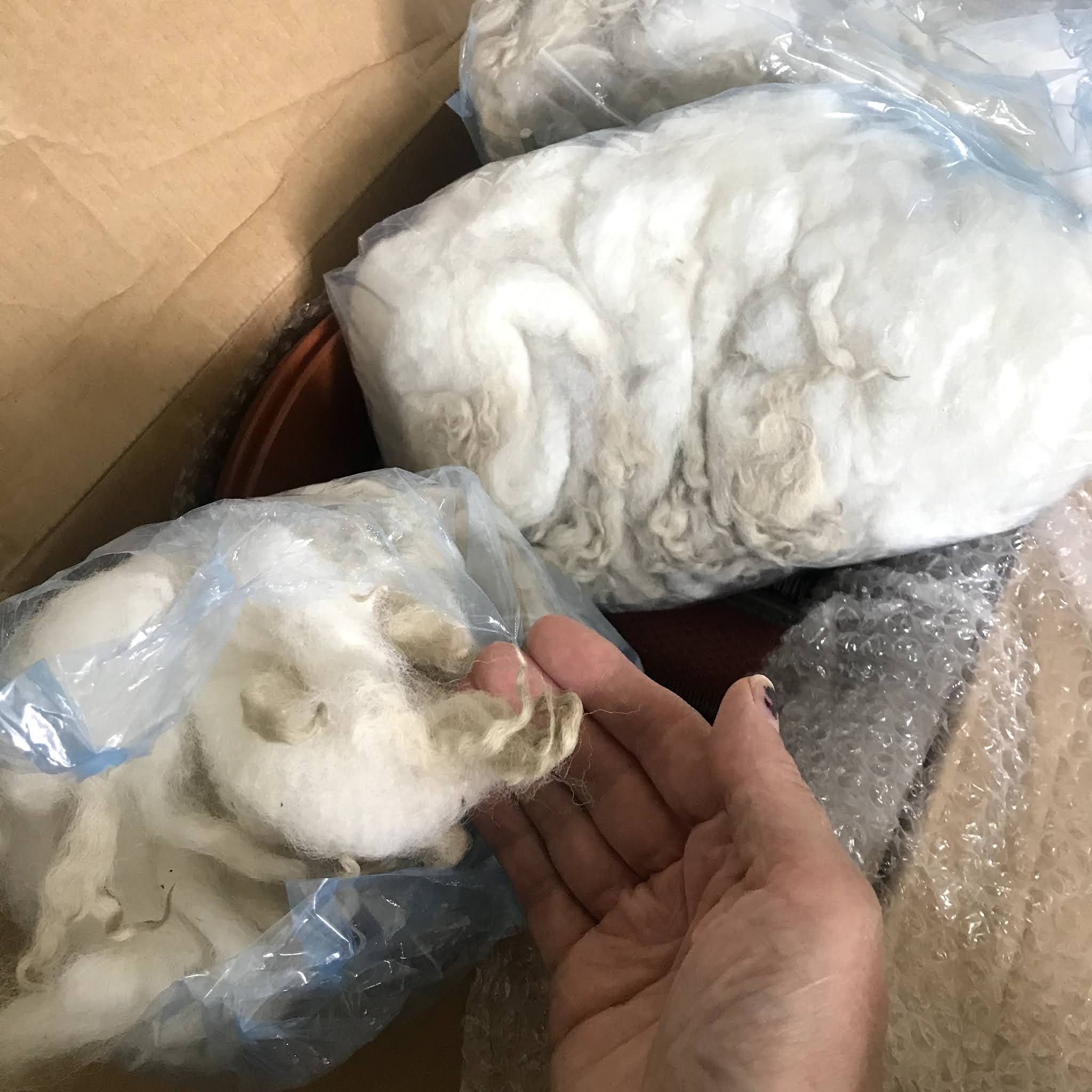
 This project started life when an inventive and generous person returned a drum carder using packing that she'd made from bags filled with the most beautiful Shetland fleece. Of course I treated this as a gift, and a very welcome one.


Those amazing and long locks are really from a Shetland sheep raised in the very north of Scotland. The prettiest of the flock, she is nicknamed Mrs White Fleece. They are strong and didn't break when snapped between the fingers (this type of fleece has a 'rise' or natural weakness which causes the fleece to moult or at least be capable of being 'rooed' or plucked by hand.)

I like to be intentional and spin for a project. In this case I spun the fleece first. I drumcarded, crudely split and pulled the batts into nests and spun from the end of the 'roving'.


This yielded around 500 yards of yarn. More than enough for socks but not enough for a cardy. By searching patterns for the right yardage and yarn weight, I chose this project - Earth Mama legwarmers by Nat Raedwulf, which as an added bonus is a free pattern.

They didn't take too long to knit because I was keen to wear them. I broke two cable needles along the way. Bad technique rather than bad cable needles.


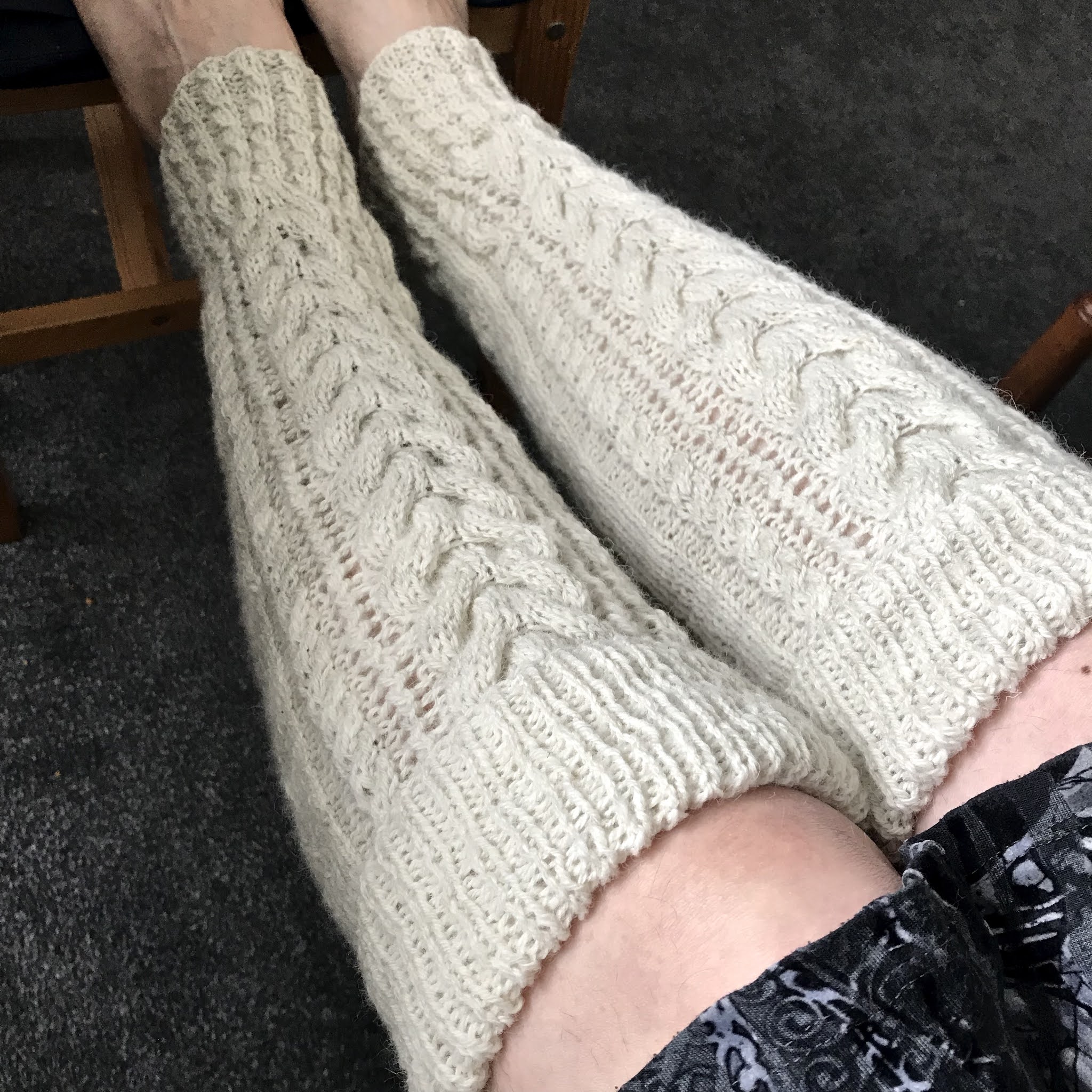
In this picture they have yet to be blocked, which will even out the stitches a little, and have to have buttons added on the turned-over cuff. (The pattern includes a buttonhole.)

Ever since casting off I have been wearing them. (So they're still not blocked.)  They are incredibly warm and snuggly. They stay up well and I like the way the lower ribbing opens out over your foot.

Finished Fulton Shrug

The pattern is mad and I love it - Fulton Shrug from the great book Unexpected Cables.

Yarn is not handspun but Norfolk Horn sourced and millspun by my friend Jenn at fibreworkshop.co.uk and then dyed for me by Freyalyn.  More details about all of that in the previous post.

It has taken a long time. The cables added to the time but kept it more interesting than plain knitting. I got into a rhythm of knitting one or two repeats most days (a cable cross round every 8 rounds).


WIP: Fulton Shrug in Norfolk Horn yarn

 My current project isn't handspun <gasp> but it is very special yarn.


The yarn comes from the lovely Jenn at https://fibreworkshop.co.uk who sourced the Norfolk Horn fleeces and had them processed and mill spun. I bought this undyed, but Jenn does also dye her yarn using natural dyes, either home-grown or with a local connection.


I considered dying the skeins myself but I wanted a professional job for this project, and sent them to the also lovely Freyalyn who did this amazing job and achieved exactly what I wanted; a teal colour with a little variegation. 


The pattern is Fulton Shrug from Unexpected Cables. It probably won't be the only pattern I knit from that brilliant book.

Amazing Alaska hat pattern with handspun yarn

When I first saw it I knew I had to make one. The pattern is Alaska by Camille Descoteaux
This pattern looks fabulous in a colour-changing yarn paired with a dark solid colour for the silhouette trees. More comments about the pattern after the knitting pictures.

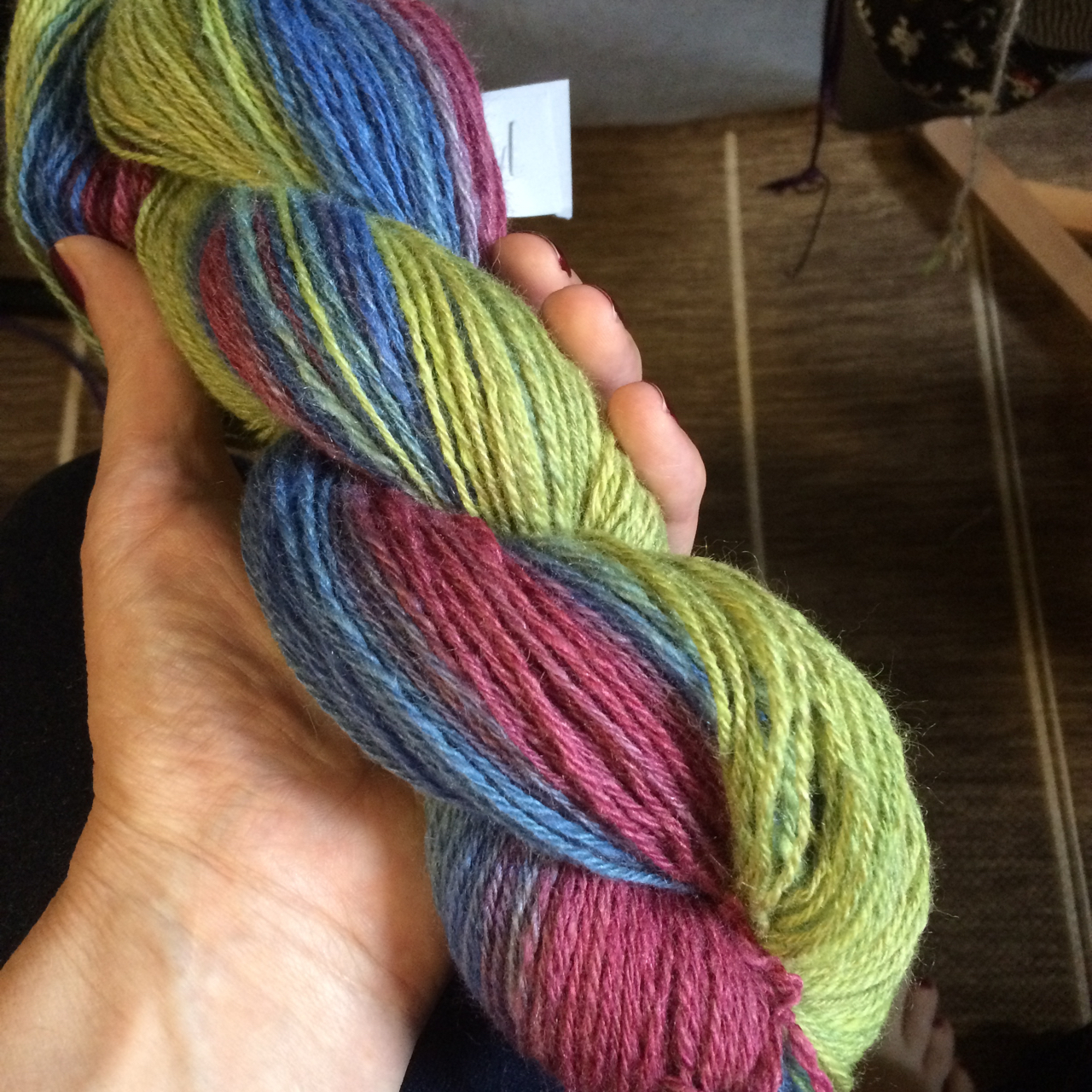
Usually I spin especially for a particular project, but this time I had the perfect yarn. It’s a Freyalyn long gradient I bought at a show and then spun during Spinzilla 2017.

The dark colour was also spun during Spinzilla, possibly not the same year. I think it’s real Shetland from Adam Curtis.

There follows a bunch of pictures of the fibre, the spinning, the finished yarn and 'in progress' shots of  the knitting.

Above is the fibre as I bought it. Below is me preparing it in advance of Spinzilla 2017. I like making 'fauxlags', it's a very fast way to spin. You open up the fibre into a flat sheet and then roll the fibre around a dowel or large needle to form a rolag or puni shape.
I spin these longdraw. Pinch off about an inch while treadling madly and using a high-speed ratio. Pull back about a metre at a time as it gains twist. I spun this pretty fine because I wanted to chain-ply aka navajo-ply

 The navajo plying produces a neat, round yarn. It also concentrates colour and preserves colour changes like these.

 So that's the finished yarn in a photo from 2017.

I began knitting a month ago.


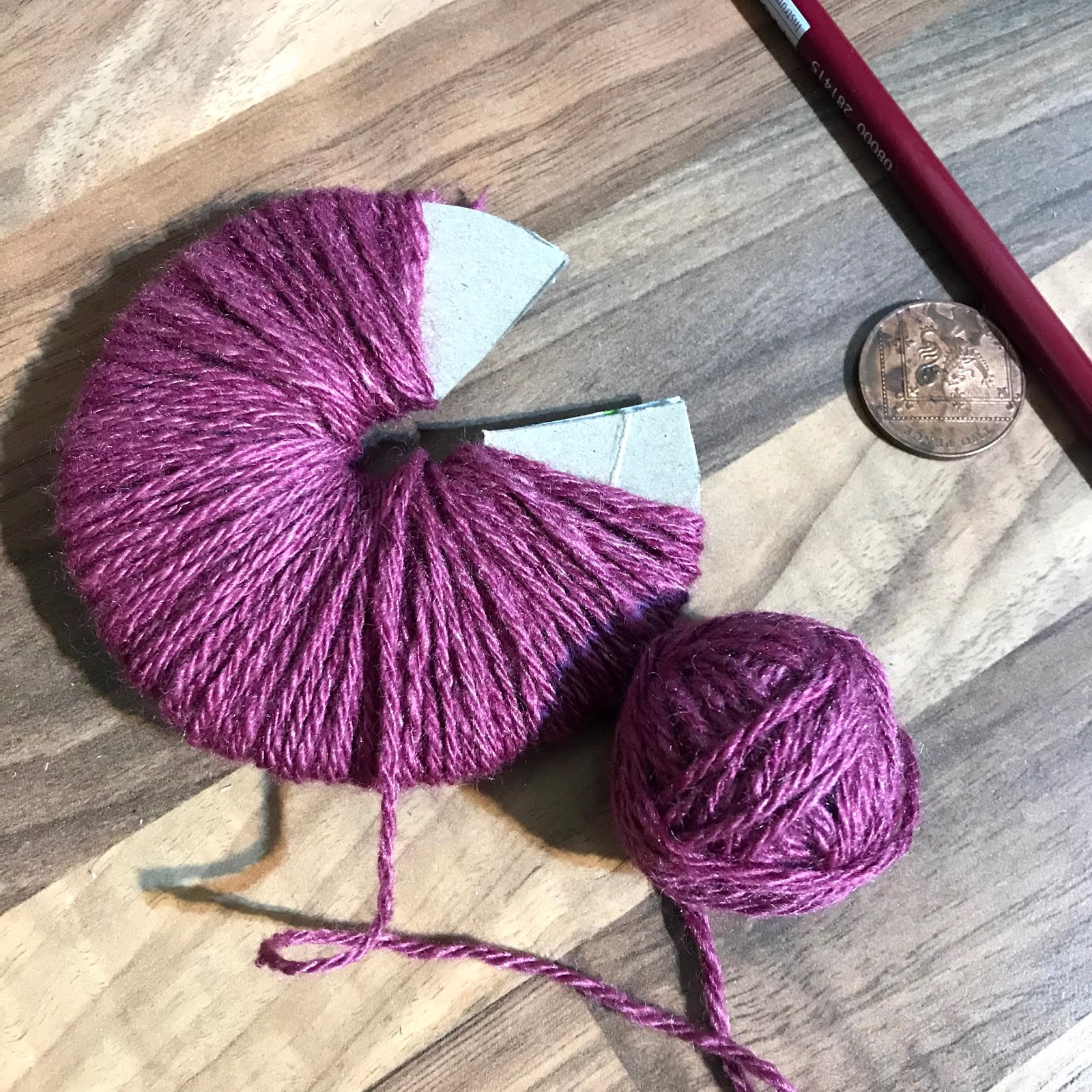
I've not made a pompom for about 45 years.


I found the pattern a delight to knit. The only thing that annoyed me a little is the long floats as you near the end of the colourwork, but I became quite slick at crossing the yarns every 4 stitches to anchor the floats.

Ravelry project here.