Summer Flies

Do your knitting habits change with the seasons? Craftsy magazine held a survey on Facebook and found the top answer to be 'the weather doesn't affect my knitting'. The next highest answer was that projects become smaller; hats and socks.

In response to this, Stefanie Japel has put together her top five free summer patterns.

I guess that like me, you are not often moved by many of the patterns in a top five, but these ones really grabbed me, I've bookmarked three of them.

The Summer flies shawl (I assume meaning that Summer goes quickly, not a reference to the insects) looks lovely and is said to be quick and easy to knit. The Ornamental Socks have a fascinating heel! And the Suntrap Scarf just looks beautiful and summery.

The scarf is similar to one of my own WIPs and reminds me that I should get on with it!

Read more.

Project Spectum - Green

This is my contribution to Lolly's Project Spectrum. This year she's concentrating on the 'additive' primaries', the basics of coloured light rather than pigment. For June she'd like us to focus on green.


She's set a challenge to capture some greens in your neighbourhood.

Easy! I took this photo on Saturday on a circular walk starting from home. Being in the middle of The National Forest, there's lots of young forest around, including these poplars just beyond Smisby. I've made this picture available in various sizes for desktop / wallpaper at http://uk-walks.info/desktop-wallpaper.html

It's nice to combine my walking with my fibre crafts!


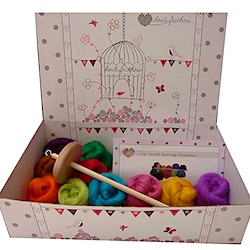
decorated drop spindle


Most Ashford products often come in 'natural finish' which is a nice way to say that the wood needs finishing somehow, stain, oil, wax, varnish, the choice is yours. Some things come lacquered or have a lacquered option.

But the great thing about the natural finish is that it gives you the chance to get your creative mojo on.

Drop Spindle Spinning

If you're a knitter or just curious about spinning, then this free eBook is for you!

It contains excerpts from well-established books from Lee Raven, Maggie Casey, Amy Clarke Moore and others. You can learn how to make a spindle for yourself and spin & ply your first yarn!

The free download requires you to give your email address to SpinningDaily, but their regular emails are often interesting and worthwhile.

Read more.

Weaving with a harness loom - 6 things I've learned

I've been doing more weaving recently, and with a bathroom redecoration 'looming', this article has inspired me to make a pair of curtains for the smallest room.

It also contains some good easy-to-follow guidance about calculating yardage needed for warp and weft.

Much experimentation with yarns and patterns has yielded some results I really like. The ideal colour came from handspun made from my gold-ish 'fairy wings' blend in merino and silk (warp is cream cottolin). For the main part of the curtains it's going to be this herringbone weave, and check out the 'waffle' weave! That will make a great decorative border!

One really nice surprise is that the work is translucent! Light behind this sample brings out the patterns and the gold colour.

That surprise has inspired a matching lampshade too!

(Yes, you guessed - that second picture is cropped because the edges looked really untidy!)

Here's the promised list of lessons learned along the way:

1. Warping takes time and is intricate work, and when you want to weave a different pattern it generally means threading up differently. But with a little application and a good audiobook, it's relaxing and enjoyable.

2. Care taken when threading can save lots of time re-threading.

3. Once warped, the weaving process is very quick and rewarding

4. Weaving with singles is perfectly good and the work doesn't bias as knitting can.

5. There are many permutations of similar or different warp and weft (colour and thickness) giving a wide variety of fabrics.

6. Repairing broken warp threads is possible but it's a bit of a pain and far better to take care and not break them in the first place.


So - a secondhand four-shaft loom of a suitable width has been procured - pencil is in hand to calculate my number of ends and yardages, and then it's carding, spinning and warping. Most interesting redecoration I've ever done!

Still time!


There's still time to enter this year's Spring competition, a good prize on offer and not a huge number of entries so far. So why not give it a go?

I'm inviting you to make some yarn inspired by this springtime photo of cherry blossom.

It's a freestyle event - do whatever you like, dye the fibre, mix bought dyed or natural fibre, use animal, vegetable or synthetic, straight or funky, whatever you like. To enter, join the group on Flickr and add your photos. If you have trouble with that, simply email them to me. you've got until mid-May.


time-travelling spinning wheel

One very dirty spinning wheel (or rather a pile of dirt that turned out to have a spinning wheel underneath) + bowl of slightly soapy water = very shiny wheel plus what looks like... cloudy beer?

To be more serious, this wheel demonstrates the protection that Ashford's factory-lacquered finish gives. It's not been a decorative item - there are signs of use - and it's been neglected as evidenced by a thick layer of dirt and some rust on some metal parts. Features of the wheel put its birthday between 1975 and 1982.

But a wipe with slightly-soapy water and a deep shine is revealed. There are no signs of shrinkage or cracking as are sometimes seen on its stained contemporaries. The lacquer is hard and gives good protection against knocks and scratches - few can be seen. Stand back and it looks much newer than it really is. Having replaced a few lost or broken consumable parts (spring, brake and drive band, treadle joint), oiled the moving parts and it spins as well as the day it was made. And I'm sure it still will for many years to come.